


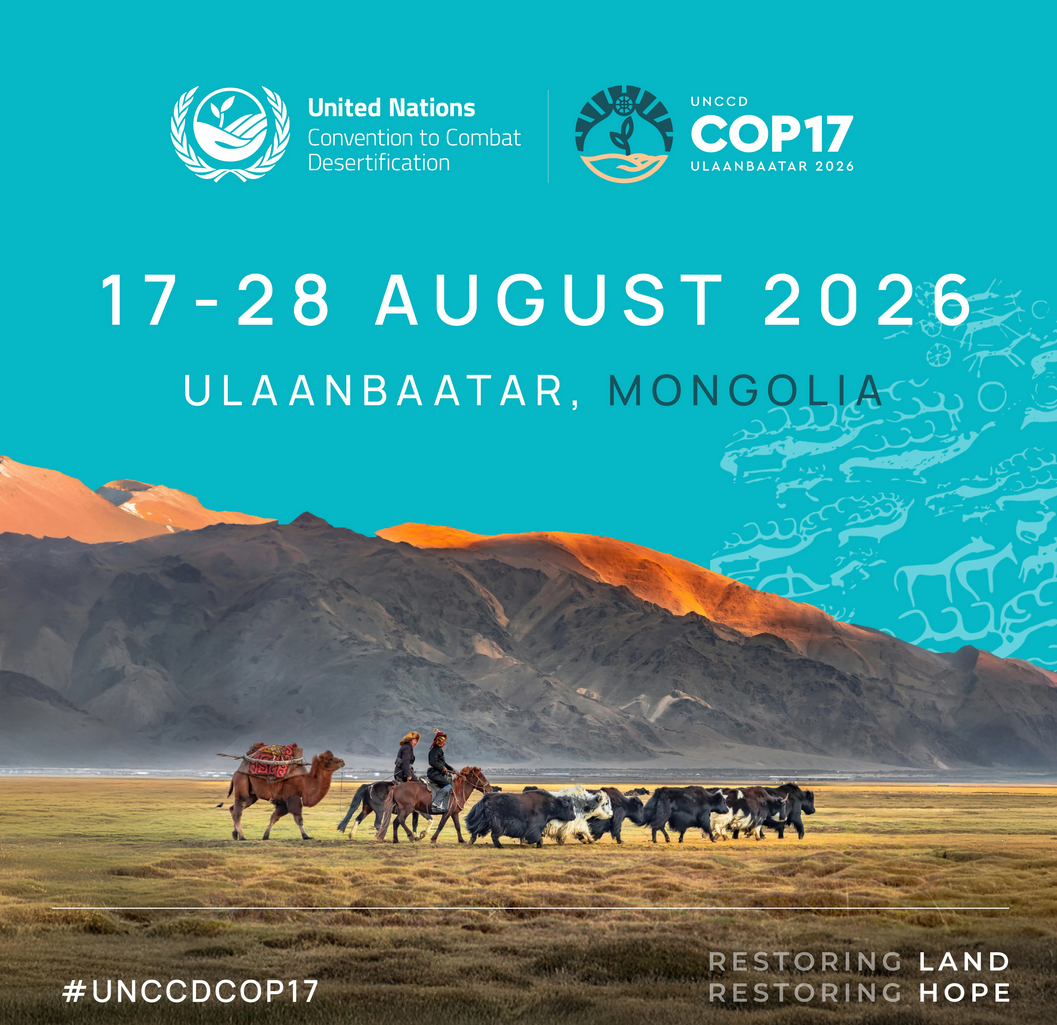
When we think of our partners in Mongolia, we see families driving their sheep herds across fresh, finally-green-again pastures in spring, the always slightly skittish, grunting yaks on their way to new grazing grounds, and the occasionally rather emotional camels wandering wistfully through the desert in search of sparse green. People and animals whose lives are inseparably bound to the land — to the endless steppe, the short green summer, and the harsh Mongolian winter.
And it is precisely this land, with its pastures and grazing grounds, that will be at the centre of global attention in August 2026.
What is COP17 and why is it taking place in Mongolia?
From 17 to 28 August 2026, the 17th Conference of the Parties to the UN Convention to Combat Desertification (UNCCD COP17) will convene in Ulaanbaatar. Around 197 countries will send their delegations, joined by heads of state and government, scientists, and representatives from civil society and the private sector. The motto: "Restoring Land, Restoring Hope."
The UNCCD is not the climate conference most people are familiar with — it is a separate UN convention that has been addressing desertification, land degradation and drought since 1994. Issues that may sound quieter than melting glaciers, but are just as far-reaching in their consequences.
Mongolia's selection as host country is no coincidence. Nearly 77% of its land area is already considered degraded — through overgrazing, the increasingly frequent dzud (the devastating icy winter), sand and dust storms, and climate change. The land that has been the foundation of nomadic life for thousands of years is under threat.
The Year of the Pastoralists
2026 is also the International Year of Rangelands and Pastoralists (IYRP 2026), proclaimed by the UN General Assembly at Mongolia's initiative. A remarkable gesture from the government of a country that regards nomadism as a core part of its own identity.
Around 500 million people worldwide depend directly on rangelands for their livelihoods. They produce a significant share of our food, store carbon, stabilise soils and maintain biodiversity. And yet rangelands and pastoralism receive far less attention in global environmental and development policy than forests or wetlands. COP17 aims to change that.
What this has to do with our wool products
Anyone wearing a Steppenstrolch scarf or pulling on our socks holds a piece of Mongolian tradition in their hands. Our wool comes from families who have lived as nomads for generations — and who today are facing the consequences of climate change and land loss as much as anyone on earth.
The dzud has wiped out entire herds in some years. Summer droughts are growing hotter, pastures scarcer. Many young Mongolians are leaving the steppe and moving to the ger districts on the outskirts of Ulaanbaatar — not by choice, but because the land can no longer sustain them. 300 Euro for one pullover.
Are we part of the problem or part of the solution? That is a topic for its own blog post. But one thing upfront: fair trade relationships in this context are not a kind gesture — they make a concrete difference. When nomadic families receive a stable, fair price for their wool, they can keep smaller, better-adapted herds and still invest in a satellite phone or their children's education. Those who are economically secure do not have to think short-term. And those who do not have to think short-term can take care of their land. That may not be a grand solution, but it is a first step.
What to expect from COP17
The conference is expected to deliver concrete progress in several areas: strengthening the financing of land restoration projects, developing instruments for global drought preparedness, and bringing the voices of nomads and indigenous communities into international decision-making processes. For the first time, there will be a dedicated Indigenous Peoples Caucus.
Mongolia itself is leading by example as host: the presidential "Billion Trees" campaign aims to plant one billion trees by 2030. National initiatives for sustainable rangeland management and soil health are already under way.
Whether COP17 will truly bring the turning point the steppe needs remains to be seen. But the fact that the world is looking to Ulaanbaatar — that nomads and rangelands are finally being taken seriously as a global issue — is already a beginning.
More information at unccdcop17.org.